




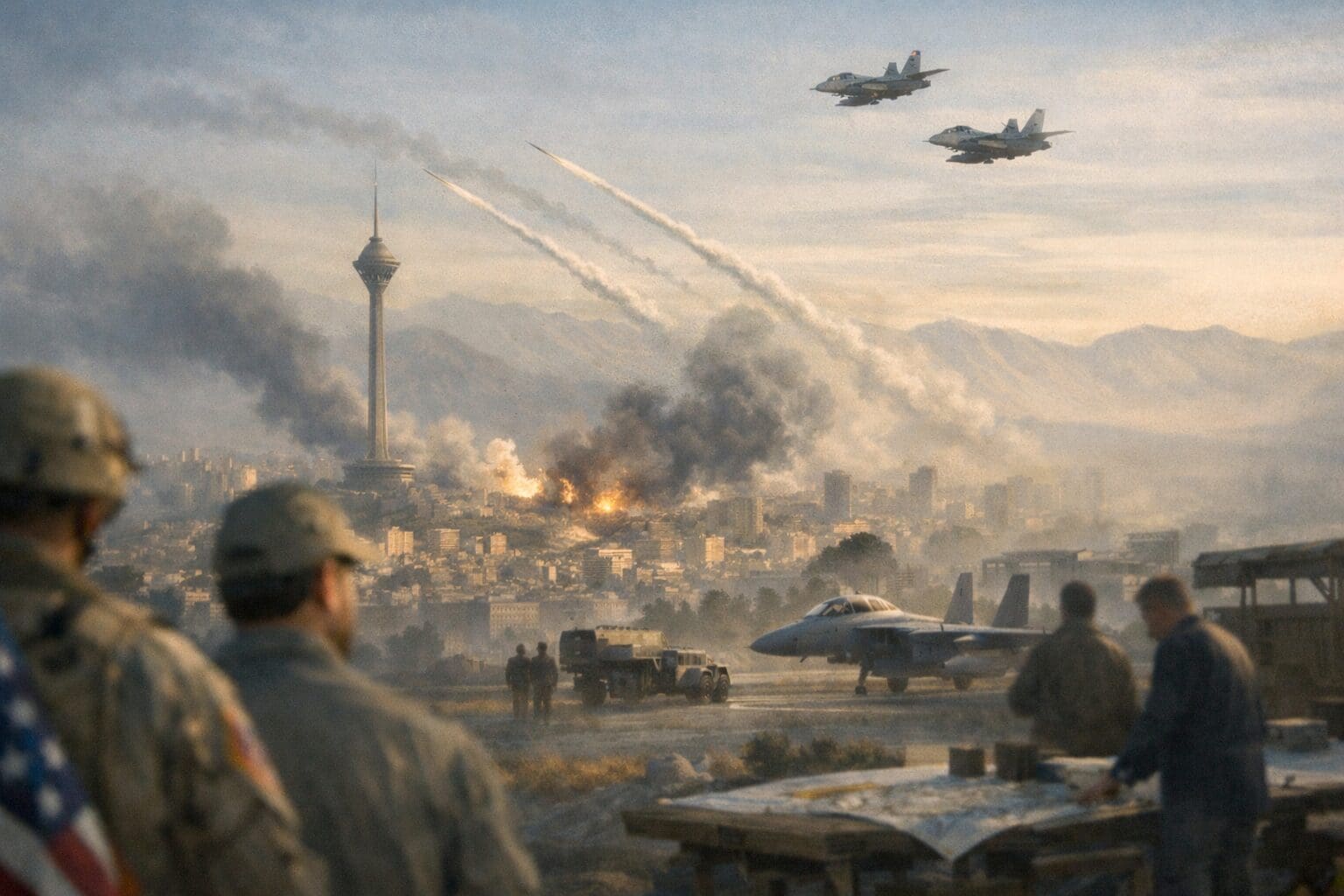

Cynicism, illusions, and imperialist ambitions are accompanying the bombs raining down on Iran in this war between gangster states. Public feuding between President Donald Trump and Prime Minister Benjamin Netanyahu had seemingly brought relations between their two countries to an all-time low over Israel’s ethnic cleansing of Gaza.
Stephen Eric Bronner*
Cynicism, illusions, and imperialist ambitions are accompanying the bombs raining down on Iran in this war between gangster states. Public feuding between President Donald Trump and Prime Minister Benjamin Netanyahu had seemingly brought relations between their two countries to an all-time low over Israel’s ethnic cleansing of Gaza. But the differences between them were grossly exaggerated by liberal media. This second and far more intense bombing of Iran, which followed the attacks of June 2025, was planned well in advance. The United States and its regional proxy, Israel, share a common desire to assert the latter’s hegemony over the Middle East.
Why did the bombing of Iran happen now? Yes: Trump wished to deflect attention from the Epstein files, the fascist tactics of ICE, the “affordability crisis,” a host of diplomatic setbacks, and a sinking approval rating that stands at 43%; indeed, Netanyahu’s numbers have fallen to 30%. Both leaders need a win. Attacking the retrograde Iranian regime should appeal to independent voters and Trump’s base. It should do the same for Netanyahu, who will only gain support from the orthodox religious-settlement parties on which his coalition rests. And the risk seemed worth taking: Iran looked weak in light of lingering effects from the June 2025 bombings, the collapse of its national currency, and the massive early 2026 protests that swept the country. All of this made Iran appear weak—just how weak it is remains to be seen.
Geo-politics and crude realism are driving events: Trump and Netanyahu both assume that the strong can act as they wish and that the weak will suffer what they must. Only Iran has been left standing among Israel’s regional rivals: Egypt, Jordan, and Morocco have either tacitly or formally recognized the “Zionist entity”. Saudi Arabia and the Gulf States are doing brisk business with it. Syria has been torn apart by the civil war that culminated in the fall of its murderous president, Bashar al-Assad. Iraq is still plagued by the legacy of internal strife following the American invasion of 2001. Lebanon is a mess. As for Palestine, it is plagued by ever-expanding Israeli settlements, the humanitarian catastrophe in Gaza, and a crisis of sovereignty. It was not now or never when it came to attacking Israel’s most dangerous enemy, but now seemed a particularly opportune time.
Neither American nor Israeli foreign policy is unique. At different points in history, all “great powers”: England, Italy, France, Germany, Japan, and Russia pursued policies that simultaneously strengthened their regional hegemony, expanded their “living space,” secured their spheres of influence, and used horrific tactics to achieve their aims. The justifications remain roughly the same: the national interest is being served; its security requires proactive measures; the victims will benefit from defeat; and, of course, imperialism is realizing the nation’s “destiny.”
Not some biblically ordained mission of the Jewish people regarding the conquest of Judea and Samaria, not the non-existent Jewish world conspiracy described in the fabricated “Protocols of the Elders of Zion,” not American fears of a non-existent Iranian nuclear weapon, and not the desire to spread democracy, inspired the war. Far better reasons can be found. There are material and psycho-political gains that the United States and Israel would gain with respect to oil (prices), real estate, annexation projects, inflation of group narcissism, and the celebration of an unpopular president for conquering a hated enemy seem too obvious to require further elaboration.
Iran is the most vocal enemy of the United States. Defeating it would nicely complement attempts to re-affirm the United States’ regional hegemony over Latin America and the Caribbean called for by the Monroe Doctrine of 1823 and new versions of what was once known as its “manifest destiny.” National security is the lame justification for attacking “narco-terrorist” states, but also for acquiring Greenland, and the desire for more living space, which has led to demands that Canada become the 52nd state. The United States is intent on asserting itself as the independent world hegemon that is accountable only to itself. This helps explain its growing separation from Europe and NATO, its withdrawal from international treaties and organizations, and its abandonment of the multilateral approach to crisis situations.
Justifications for the bombing of Iran have shifted from the need to defend the protestors to being “proactive” in the face of an “imminent threat” to the dangers attendant on the regime building a nuclear weapon and its unwillingness to make a
deal.” But the bombing didn’t take place until the protestors were slaughtered, the CIA itself denied that an attack on the United States was imminent, and President Barack Obama had already sealed a complicated deal with Iran that prevented it from developing a nuclear device for military purposes. Insisting that he could get a better deal, however, President Trump tore up the existing agreement on May 8, 2018.
Of course, that attempt failed. Monitoring Iran became impossible as new opportunities emerged to rekindle its suspended nuclear enterprise. Given American-Israeli views and prejudices about Iran, it mattered little that Iran just recently claimed (as it had while negotiating with Obama) that it was only interested in developing nuclear energy for domestic purposes. Following the bombing of Iran in June 2025 by the United States and Israel, their leaders insisted that Iran’s nuclear facilities had been destroyed. But this was a lie: its nuclear facilities survived. Trump and Netanyahu are now trying to turn the falsehood into truth.
There should be no misunderstanding: Iran’s theocracy is corrupt, self-righteous, dictatorial, and incompetent in its administration of economic affairs. The country was experiencing a downward economic spiral, and near collapse, when its government cracked down on protesters; its criminal inhumane actions resulted in 10,000 deaths and 50,000 arrests. However, these courageous revolts in the name of democracy are intertwined with the cynical reality that we are experiencing now. The cunning of history is in effect as Trump calls upon Iranians to overthrow their regime now, because they will “never get a better chance,” and thereby heightens the prospect for further reprisals and perhaps even civil war.
What will happen once the regime falls is apparently of secondary concern just as it was before the American invasion of Iraq. Belief that the Iraqi people would celebrate the arrival of American troops was naïve at best and though opposition to its leader, Saddam Hussein, was widespread, internal divisions existed between various tribal-religious militias often with very different political aims. It was the same following the fall of Bashir al-Assad in Syria and any number of uprisings in Africa. Arguably the greatest of all political philosophers, Thomas Hobbes, warned that to topple a sovereign without having another ready to step in is a recipe for chaos; it is a lesson that the United States has yet to learn.
The stakes have only grown with the death of Iran’s Supreme Leader the Ayatollah Khamenei and various important officers of the noxious Revolutionary Guard. Unsurprisingly, the announcement of Khamenei’s death was not only greeted by joyful celebrations, but by outbreaks of public mourning. Iran is divided and the consequences appear ominous. Some members of the Supreme Council, which will choose Khamenei’s successor, have popularly based military followings. Clashing ambitions and other contentious concerns could lead them to turn against one another or, as a religious combine, against a democratic opposition whose leadership and goals remain unclear.
Meanwhile, the war is expanding as Israel sends troops into Lebanon in order to eliminate Hezbollah and Iran strikes the Gulf States and the US embassy in Riyad, Saudi Arabia. There is hardly a state in the region that that has not been subject to missile hits or worse, and President Trump has said that he might employ ground-troops, which can only mean invasion. Nor should Iran count on its neighbors for support. Iran is Shiite and Sunni Muslims in other Middle East countries are unlikely to engage in a show of solidarity; indeed, the Arab League has been notably cautious in its response to the crisis. There is also little likelihood that criticisms and condemnations will translate into serious consequences for the aggressors. The regional balance of power is secure and the religious zealots and xenophobic settlers, whose parties are keeping Netanyahu afloat, are surely happy.
Meanwhile, Iran and its citizenry are already paying an inordinate price for this Western escapade, suffering nearly 1000 dead in the first few days of the conflict and devastating attacks on the infrastructure. It is likely to get worse. American and Israeli aims remain unclear; “mission creep” is taking place as the goal shifts from forcing Iran to the negotiating table to assuring “zero” capacity for Iran to build a bomb to regime change to regional re-ordering. But, then, there is time to decide. The president who once constantly complained about American involvement in foreign wars has stated that citizens should prepare for a long conflict. Hopefully not too long, of course, since Americans tend to celebrate foreign wars when they start, but quickly become impatient when the body bags start coming home—and they will.
Opportunities exist for progressive forces to act decisively. However, most Democrats remain fixed on formal rather than substantive criticisms. They are primarily engaged in legalistic attacks on President Trump for not consulting Congress before declaring war, acting unilaterally, and ignoring the Constitution. That is insufficient. Judgments must be made should Trump’s attack on the Iranian theocracy prove successful –and the new circumstances that this might create. The Democratic Party has not offered its own version of what policies will serve the national interest when it comes to the Middle East. It has not explicitly condemned American imperialism, and it has not punished Israel for its outrageous behavior in Gaza and the West Bank. of Israel. In short, the party has not presented even the rough outlines of an alternative foreign policy. Unless Democrats rise to the occasion, their prospects for changing America’s standing in the world and recapturing its promise are bleak as the mid-term elections approach in 2026.
*Stephen Eric Bronner is Board of Governors Distinguished Professor Emeritus of Political Science at Rutgers University and President of the American Council for Justice and Conflict Resolution
Source:
europeantimes.news