Israel went to war after the Hamas-led October 7, 2023, massacre with two essential goals: to get back the hostages, and to destroy Hamas and any other potential deadly threats to Israel. Among the subsequent conditions Prime Minister Benjamin Netanyahu also vowed to impose was that there would be no role for the Palestinian Authority in a postwar Gaza unless the PA underwent radical reform.
With the return of all the hostages, living and dead, and the Trump administration’s declaration that we have now entered phase two of the US president’s broad Gaza peace plan, however, Hamas still rules half of Gaza, is targeting Israeli troops in the other half, and is not planning to disarm. And the PA, in more and less overt guises, is assuming a significant role during this fuzzy period of semi-war, semi-ceasefire. The Mahmoud Abbas-led PA, that, in a previous iteration, Hamas murderously and swiftly booted out of Gaza when seizing power there almost 20 years ago.
At President Donald Trump’s instruction, the Rafah Crossing between Gaza and Egypt has been reopened to limited entry and exit of people. And it is the PA, along with Egypt and European representation, that is managing the process — a fact that official Israel prefers not to acknowledge. (Israel, it should be stressed, is vetting and thus determining who is permitted to come in or go out, just not at the crossing itself.)
Furthermore, the main body formally delegated to oversee Gaza’s civil governance, the National Committee for the Administration of Gaza (NCAG), is largely a Palestinian Authority entity. Its Gaza-born chief commissioner, Ali Shaath, is a former deputy minister in the PA. Several more of its members have held posts in the PA, including Sami Nasman, assigned the Interior portfolio, a senior figure in the PA’s General Intelligence Service. (Nasman fled Gaza over 30 years ago, wanted by the Shin Bet over the alleged killing of collaborators during the First Intifada, and came back at the time of Yasser Arafat’s return in 1994.)
It was Shaath who announced, in a video message broadcast during Trump’s launch ceremony for Gaza’s Board of Peace in Davos on January 22, that the Rafah Crossing was about to reopen in both directions, possibly blindsiding and certainly discomfiting the Israeli government.
Shaath and his team are supposed to enter Gaza next week to take up their responsibilities — operating in the half of the Strip controlled by Hamas, which was directly involved in the talks in Egypt that determined who would sit on the committee.
Ahead of its first days on the job, the NCAG this week cut through the diplomatic euphemisms and misnomers and changed its logo — from the original design of a bird in Palestinian colors to the PA’s very own eagle with flag symbol, merely switching the word “Palestine” to NCAG. A case of “in your face, Israel.”
What the symbol symbolizes, of course, is that the PA is back in Gaza. Back, that is, alongside, at odds with, and outmuscled by its sometime rival, ally and enemy Hamas.
Practically speaking, this portends a West Bank-style reality for Israel.
Netanyahu will likely resist withdrawing the IDF any further from the Strip, because Hamas will either overtly refuse to disarm or attempt to disguise its retention of weaponry by ostensibly entrusting it to the NCAG — the committee it helped select and with which it will have an extremely fraught relationship.
After four hours of talks with Trump’s key envoy Steve Witkoff on Tuesday evening — talks that surely focused in large part on Trump’s preparation for war and/or diplomacy with Iran — a brief statement from Netanyahu’s office chose to focus on Gaza. It emphasized Israel’s uncompromising demand for Hamas to be disarmed, Gaza to be demilitarized, and the PA to be excluded from “governing the Strip in any way.”
But rhetoric aside, the PA is already playing a role in Gaza. And Hamas, as the IDF recently informed Netanyahu, is deepening its hold on the non-IDF-held half of the Strip — including by “integrating its operatives into government ministries and the security apparatuses.”
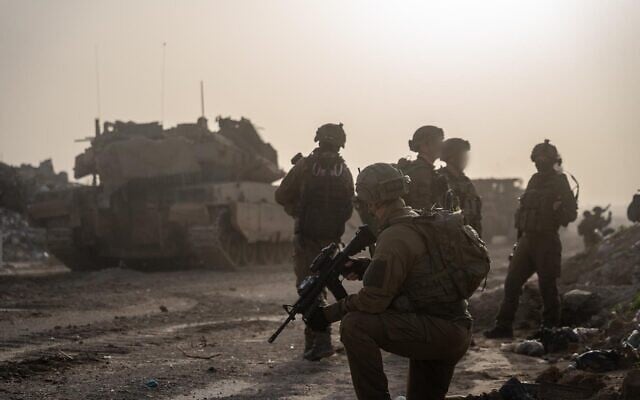
As things stand, Hamas will continue targeting Israeli troops. The IDF will continue to hit back. In the short term, the US will doubtless attempt to maintain the ceasefire that came into effect in October, Trump may repeat his declared assessment that Hamas “is going to disarm,” and he may keep on declaring that he brought peace to Gaza.
But what is unfolding on the ground is no recipe for security and stability. It stems at least in part from Netanyahu’s failure in the highly complex task of enabling the installation of credible, effective non-Hamas governance. With the government seeking to eliminate Hamas, and refusing to consider the PA for any legitimizing role in an international mechanism, we are winding up with both of them. And that certainly does not meet Israel’s essential war goals.
This is not the Gaza that Israel, after indescribable cost in lost lives and in its global reputation, wanted and needs to see after the war.