
[ad_1]
There is one area where Homo sapiens continues to reign supreme, and alone: figurative art. No other species has been making any. Until the 1950s or even the 1960s, we also thought that only we and our predecessors were capable of manufacturing and using tools. « Tooling » was considered definitive of humanity.
It wasn’t and now we have been delivered the final humiliation by a cow.
« Our findings broaden the taxonomic scope of flexible tool use and invite a reassessment of livestock cognition, » say Antonio J. Osuna-Mascaró and Alice M.I. Auersperg, authors of the paper on Veronika the cow’s mad tooling skills in the prestigious Cell journal Current Biology.
Related Articles
Actually, humanity has long since wised up from our pretension. We have belatedly observed tool manufacture by others. A captive bonobo astonished science by using her teeth to shape a branch into a spear, in order to stab an annoying researcher in Israel.
 Close
Bonobos had not previously been observed manufacturing weaponry, though chimpanzees in general are famous for holding grudges.
Chimpanzees clean twigs to use as hooks to fish for termites and bees, which counts as toolmaking; they sharpen sticks to stab with; and they have even been observed chewing leaves into spongy material to clean wounds and wipe their bottoms after loose stools, and their genitals after sticky sex.
Birds also create tools, we now know, shaping sticks and wire into hooks. Crows dropping nuts on the road so cars will squish and crack them may not count as tool manufacture but they’re using cars as tools. Moving onto the invertebrates, not many thought to seek brainiacs among mollusks yet it turns out that octopi, squid and cuttlefish modify their environment, for instance building shelters out of seabed debris. That at least counts as assembly.
There is much argument over how smart cephalopods actually are, with some scientists leaning towards « remarkably intelligent » and others thinking we are misinterpreting their puzzle-solving abilities.
Chimps and monkeys such as capuchins use stones to hammer, which is tool-using, not making. But nobody has ever suggested that domestic cows have hidden smarts. Whatever brains their bovine ancestors had, after 10,000 years of breeding for docility, the modern cow is associated with emotionality and social bonding, not problem-solving.
Then Veronika entered the room.
 Close
Herbivores with opportunity
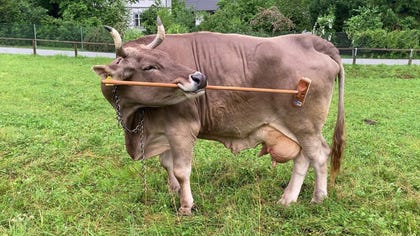
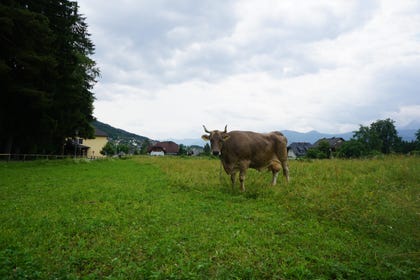
Veronika is a pet cow, specifically a 13-year-old Swiss Brown cow living in the mountain village of Nötsch in southern Austria. She belongs to Witgar Wiegele and his family who love her and have no plans to exploit or eat her.
It was Witgar, an organic grain farmer who owns an artisanal bakery, who noticed a decade ago that Veronika would occasionally pick up sticks and use them to scratch herself. That is considered unusual for a bovid. A friend of his filmed her in action and sent the video to Prof. Alice Auersperg, a cognitive biologist at the Messerli Research Institute for Human-Animal Interaction.
 Close
« When I saw the footage, » Auersperg stated, « I immediately thought: this is not just a curious behavior, this is a scientifically valuable example of a measurable tool used by a species that is traditionally overlooked in relation to its cognitive abilities. »
We don’t like to think of animals we eat as having feelings, let alone deductive powers. Cattle cognition research is not a rewarding niche. But Veronika demonstrated a capacity hitherto unrecognized in cattle: flexible, deliberate manipulation of a multifaceted external object – a broom – to achieve a goal, namely to scratch an itch.
 Close
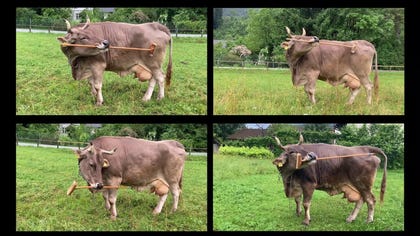
Despite over 10,000 years of domestication, research on cattle cleverness is scarce and is confined to contexts such as productivity and welfare. Thus it was startling to learn that Veronika exhibited not only personality but tooling: In randomized trials, she preferred the bristled end of the broom to scratch her upper parts but switched to the stick end when targeting soft lower-body areas that the bristles would hurt. This represents cognitive flexibility at a level previously unrecognized in herbivores.
What is the scientific background? To test flexibility, they gave Veronika a scrubbing broom with hard bristles, which was positioned in semi-randomized orientations across trials. The hypothesis was that she would choose to scratch herself using the more effective bristles rather than the stick. That proved accurate, up to a point.
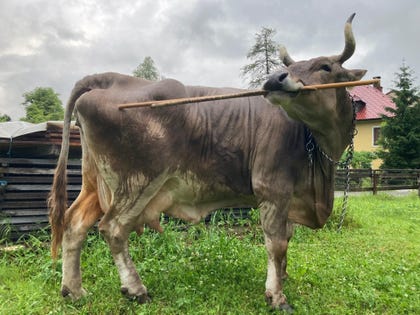
Veronika picked up the broom using her mouth, positioned it with her tongue and gripped it firmly between her teeth, creating a stable grip that allowed precise control, the researchers explain. As predicted, she used the bristles to scratch her toughened upper body and rear half, and the stick to address her sensitive lower areas, such as the udder and belly.
 Close
So what does that mean? Her behavior exhibits versatility, anticipation, fine motor targeting and choices. « Unexpectedly and revealingly, » the researchers write, her choice of which end of the broom to use was a function of target.
Moreover, her technique differed. When scratching her upper body with the bristles, she employed a scrubbing motion, lifting and repositioning the brush between movements. When targeting delicate under-areas, she used the stick end for gentle forward pushes, aiming precisely at the target. Occasionally, she would readjust the broom in her mouth to improve her grip.
That is a lot of conclusions for one cow auto-scratching but the fact is, she engaged in goal-directed, context-sensitive egocentric tooling and now we must acknowledge that we have underestimated our friend the cow.
It is true that all species have outliers: we had Albert Einstein and Leonardo da Vinci. A family member’s cat self-trained to pee in the toilet. Border Collies anecdotally understand more human speech than other dogs. Maybe Veronika is a genius among cows; the bottom line is she has become the only animal aside from us and the chimpanzee to exploit distinct properties of a single tool, effectively making it multipurpose.
 Close
« Comparable behavior has only been consistently documented in chimpanzees, » Osuna-Mascaro and Auersperg write.
It’s possible that horses do similar things, they add; possibly this kind of behavior is ingrained, and may emerge when necessary. The authors point out that for the last 10,000 years we have held cattle captive in pens, not giving them stimuli. Maybe over the millennia since we domesticated them and kept them in impoverished environments, they just didn’t have the opportunity to exhibit tool-oriented behaviors and that was the difference with Veronika. The pet cow had opportunity.
As the authors sum up: « Perhaps the real absurdity lies not in imagining a tool-using cow, but in assuming such a thing could never exist. »
[ad_2]
Source link