






Prime Minister Takaichi Sanae’s Liberal Democratic Party has secured 316 seats in Japan’s lower house, the largest majority seen since the end of World War II. Constitutional revision has now returned to the political agenda. Article 9 – the pacifist clause that has shaped debates about Japan’s security posture since 1945 – may finally be rewritten to acknowledge something that has long been obvious in practice: Japan already operates a military under another name.
That would be a mistake.
It’s not that constitutional revision would suddenly threaten Japan’s peace or stability, although claims along those lines are sure to be seized upon and amplified by Beijing. The deeper problem is that the entire debate rests on a misreading of what Article 9 has actually done in practice. The conventional narrative frames the clause as an occupation-era restriction that Japan must remove before it can respond effectively to the security pressures emerging in its region. That description no longer quite matches operational reality.
Over time, Tokyo has interpreted Article 9 in ways that stretch well beyond its original intent. The Self-Defense Forces (SDF) now operate as a modern military institution in capability if not in constitutional designation. The 2014 reinterpretation widened the scope for collective self-defense, allowing Japan to assist allied forces under defined contingencies. Defense spending has continued to rise toward the 2 percent of GDP benchmark, while procurement decisions are now reaching into areas once considered off-limits, including long-range strike capabilities such as Tomahawk cruise missiles.
None of these developments required altering the constitutional text itself.
The Gap Between Text and Reality Is a Feature, Not a Bug
The distance between constitutional language and security practice is not a mistake that needs correcting. It has been the mechanism that allowed change to occur without political rupture. Ambiguity created space for capability development without forcing a definitive break with Japan’s pacifist identity. Formal revision would close that space in exchange for symbolic clarity that satisfies some domestic constituencies while narrowing Japan’s strategic flexibility.
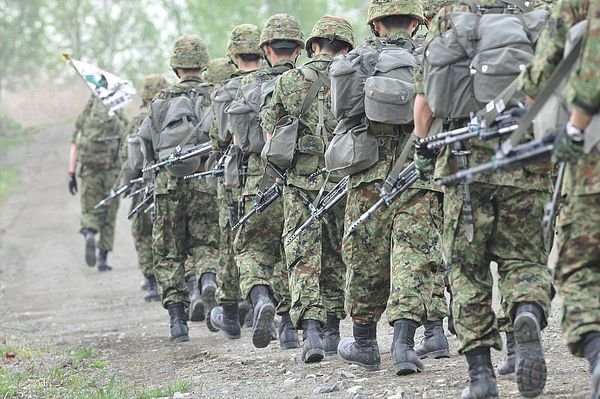
The SDF functions as a military in everything but constitutional designation. Their helicopter destroyers operate F-35s. Long-range strike weapons have entered procurement planning. Japan fields one of the most capable naval forces in the Western Pacific. When Takaichi stated that a Chinese invasion of Taiwan could invoke Japan’s collective defense clauses, the reaction in Japan was muted. Two decades ago, such a statement would have provoked sharp domestic controversy.
Normalization occurred gradually because it did not require the public to make a binary choice between pacifism and remilitarization. Constitutional revision would threaten that political elasticity.
The Case for Revision Does Not Hold Up
Defenders of constitutional revision tend to rely on two claims: signaling resolve and boosting domestic legitimacy. Neither is especially persuasive when measured against how security policy already operates.
China and North Korea do not misunderstand Japanese military capacity. Beijing tracks missile deployments across the Ryukyu chain and monitors joint exercises closely. Pyongyang plans around Japanese missile defense capabilities as a matter of routine. Constitutional revision would not alter their threat assessments. It would, however, reinforce Beijing’s narrative that Japan is abandoning postwar restraint, a claim Chinese officials have advanced for years regardless of Japan’s actual posture.
The domestic legitimacy argument is probably the weakest one revision proponents make. Yes, the SDF has trouble recruiting – but that is a demographic problem, not a referendum on the forces’ constitutional standing. And what revision advocates tend to skip is why public acceptance has been so durable in the first place: most Japanese genuinely don’t experience the SDF as a military. The distinction between jietai (self-defense force) and guntai (military) isn’t splitting hairs – it reflects something real. Japanese people consistently express surprise upon learning Japan ranks among the world’s top defense spenders, because the SDF has spent decades presenting itself as an organization that runs field hospitals and airlifts disaster relief, not one that fights wars. That framing has worked. Revision would force a public reckoning with the SDF’s identity.
So the ambiguity has held because it fits what people already think is true. Revision would blow that up – it would demand the public take a side in an argument most of them have been comfortable not having. That’s not a small thing to throw away for the sake of legal tidiness.
What revision would deliver is symbolic resolution for constituencies that view Article 9 as a foreign-imposed relic. That sentiment has emotional force, but it does not automatically translate into strategic necessity.
Other democratic states maintain powerful militaries without constitutional specificity governing force structure. The United States built its modern national security apparatus without formal constitutional amendment. Britain operates without a written constitution. France’s constitutional evolution did not determine the continuity of its military establishment. Japan’s experience fits that broader pattern: institutional adaptation has mattered more than textual revision.
The Strategic Problems Revision Creates
Japan’s most pressing strategic challenges would not become easier through constitutional revision. Alliance management would still require careful calibration. North Korean deterrence would still depend on credibility sustained over time. China’s regional weight would still demand measured balancing rather than rhetorical escalation.
U.S. defense commitments are strong but not immune to political debate. Burden-sharing discussions surface regularly in Washington. Some analysts argue revision would demonstrate Japanese resolve and ease U.S. concerns. The logic cuts both ways. If Japan formalizes unconstrained military authority, questions about alliance necessity become more rather than less salient. Constitutional ambiguity has long functioned as part of the alliance bargain. Removing it changes the political calculus on both sides.
Taiwan introduces an additional layer of complexity. Japan has increasingly signaled willingness to support U.S. contingency planning in a Taiwan crisis, though always with deliberate imprecision. Constitutional revision would narrow that imprecision. External expectations would harden. Policy flexibility would shrink accordingly, particularly in moments when crisis signaling benefits from calibrated ambiguity.
The threat environment Japan faces is both real and immediate. North Korea’s nuclear arsenal continues to expand, and missile testing has already forced adjustments in Japanese defensive planning. China’s military growth presents a different form of pressure. Its capabilities are regionally concentrated, placing Japan within immediate operational reach. The cumulative effect is a security climate defined by sustained tension rather than episodic crisis.
Japan has responded incrementally, with modernization programs and deepening alliance coordination. Planning assumptions now incorporate contingencies that would once have been politically difficult to articulate. These shifts all occurred without constitutional revision, emerging instead through reinterpretation and procurement decisions.
The more consequential changes lie outside the constitutional text. Movement toward higher defense spending carries operational consequences. Acquisition of longer-range strike systems reshapes planning horizons. Integration with U.S. forces in Japan’s southwestern islands alters local force posture. Training relationships with partners such as the Philippines expand Japan’s regional presence over time. These developments influence military balances directly.
Constitutional revision would operate primarily at the level of symbolism while leaving those material dynamics largely intact.
A Path Forward: Strategic Ambiguity Over Symbolic Clarity
Symbolic politics has real effects. It shapes domestic perception and international interpretation alike. Revising Article 9 would consume political capital and sharpen internal divisions. Regional suspicion would rise. Alliance management would become more complicated in practice. Pressure for explicit Taiwan commitments would likely intensify as well.
Japan’s postwar trajectory produced an unusual equilibrium. Military capability expanded even as pacifist language remained in place. That tension created maneuvering space rather than paralysis. Constitutional defenders have often overstated the clause’s restraining power. Institutional design and alliance frameworks have played larger roles. Yet the opposite claim – that formal revision is required for military normalization – also misreads how Japan’s security evolution has unfolded.
The distance between constitutional text and strategic practice does not necessarily need to be closed. For decades that space has allowed Japan to adapt to shifting security pressures without forcing a divisive reckoning at home or sending sharper signals abroad than Tokyo may actually intend. Ambiguity, in this context, has functioned as a strategic asset rather than a liability.
Japan can continue strengthening the forces it requires without constitutional revision. The interpretive flexibility that frustrates legal purists has enabled steady adaptation to real security pressures while preserving political cohesion at home. Japan’s defense posture rests on capability development and alliance coordination. Constitutional language has played a secondary role. Preserving that hierarchy still looks like the wiser course.
Source:
thediplomat.com