






For the past few days, the world’s oldest and youngest transnational institutions have been riding high. In fact, these institutions — the Roman Catholic Church and the European Union — seem to be riding the winds of a Zeitgeist, or “world spirit,” one that promises better days ahead for our battered and embattled ideals of liberal democracy, common decency and shared humanity. Suddenly, it appears there is reason for hope.
But the hope, held by some on the political center and left in Israel, that this mighty wind will gust as far as Israel may well be a hope misplaced.
Let us first take the youngest transnational institution. On Sunday, an event of seismic proportions rocked the European continent. The prime minister of Hungary, Viktor Orban, who gave to the world the model of illiberal democracy and gave to Hungarians deepening immiseration over the past 16 years, was voted out of office.
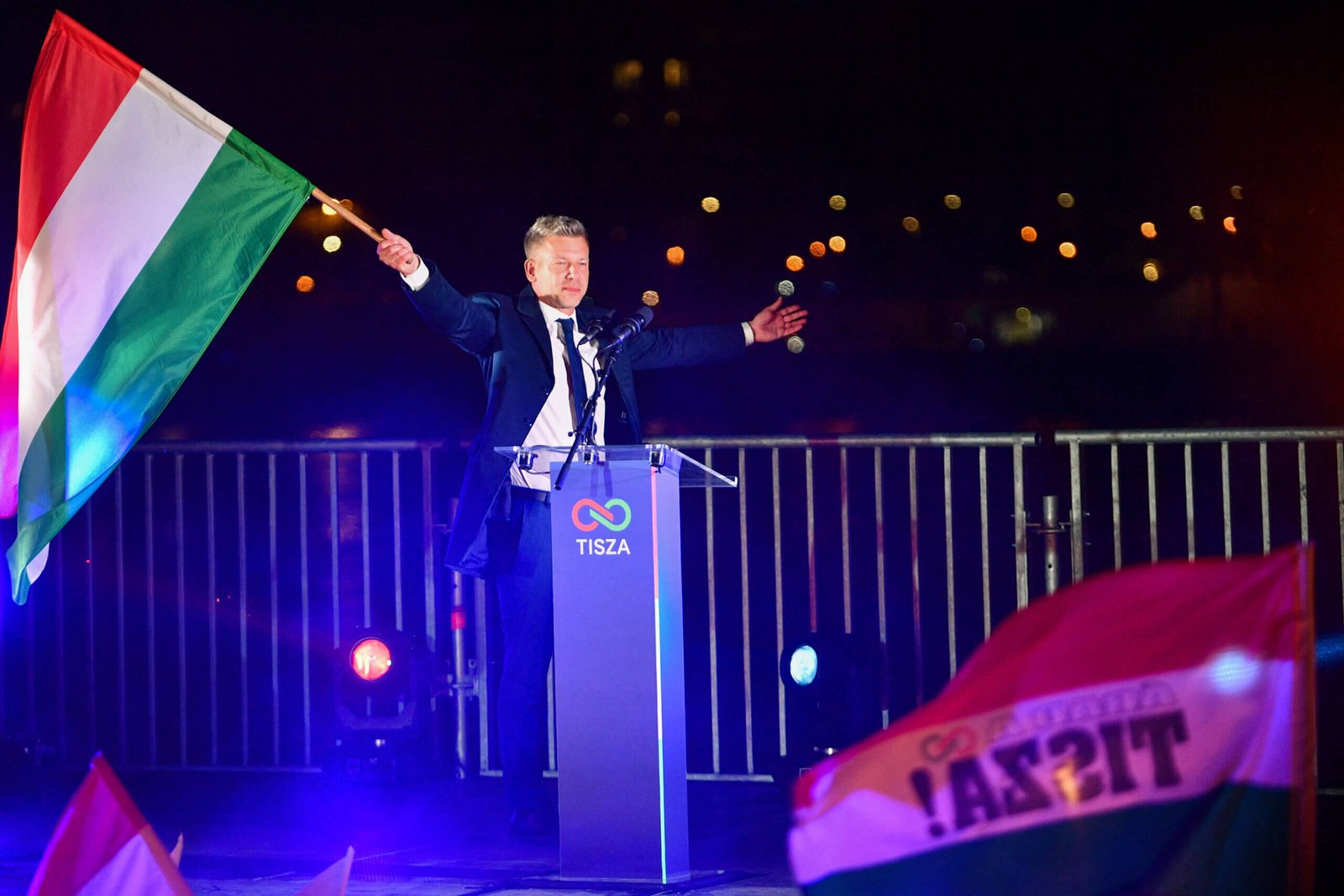
It was not close: The opposition party Tisza, led by Peter Magyar, won 138 parliamentary seats while Orban’s party, Fidesz, managed to claim only 55. This assures the new government of the 2/3 majority required to change the laws passed under Orban that hobbled the EU, disabled the nation’s political institutions, and enabled him and his cronies to line their pockets. In his victory speech, given by the right bank of the Danube in front of the Parliament building, Magyar declared to a wildly cheering crowd that Hungary is back not only as a European nation, but back fully as a EU member. Hungary, he announced, “will be a solid ally of the European Union.”
On Palm Sunday, a different crowd — holding aloft not the flag of the European Union, but instead olive branches — welcomed Pope Leo XIV at St Peter’s Square. In his homily, he took aim at the moral corruption of the American government, one that launched a reckless military campaign against Iran (as well as a foolish political campaign in Hungary on behalf of Orban). Responding to Secretary of Defense Pete Hegseth’s repeated invocations of Jesus Christ to justify his blood lust, Leo cited Isaiah: “Even though you make many prayers, I will not listen: Your hands are full of blood.” He returned to this subject during a peace vigil, praying for a kingdom of “dignity, understanding and forgiveness” to stand as a “bulwark against the delusion of omnipotence that surrounds us and is becoming increasingly unpredictable and aggressive.”
These remarks did not sit well with Donald Trump, who unleashed a series of bizarre accusations on Truth Social, declaring that “Pope Leo is WEAK on Crime,” “terrible for Foreign Policy,” and “WEAK on nuclear weapons.” Leo should “get his act together as Pope,” Trump said, “and stop catering to the Radical Left.” A few days later, after Leo failed to get his act together and instead decried Trump’s threat of carrying out a genocide against the Iranian people, the president declared that “he was not a big fan” of the Pope. When asked about these remarks, Leo replied, “I have no fear of the Trump administration, or speaking out loudly of the message of the Gospel, which is what I believe I am here to do.”
The Israeli government, one imagines, is not a big fan of the Pope, either. In a recent Sunday Mass, he addressed Israel’s campaign against Hezbollah, lamenting the deaths of more than 2,000 Lebanese, including 165 children and 250 women. Political and military leaders, he declared, have the “moral obligation to protect the civilian population from the horrific effects of war.” Nevertheless, Prime Minister Benjamin Netanyahu continues to rule out a cease-fire even as negotiations between Israel and Lebanon are set to begin.
No less predictably, opposition leaders in Israel have embraced the results of the election in Hungary. Writing in Hungarian — the language of his father’s family — Yair Lapid rushed to congratulate Peter Magyar on his victory, while the former defense minister Benny Gantz, also of Hungarian descent, expressed his hope that Hungary will be a “beacon of western values and moral clarity within the European community.”
Gantz’s words lacked the necessary clarity for Yair Golan, the leader of the Democratic Party, who cut to the chase: The election revealed that the “Hungarian public is fed up with corruption, incitement and the shattering of democracy.” Israel, he predicted, will “soon” experience a similar turnabout.
But there’s a rub. If the current zeitgeist does embody a renewal of a democratic and humanistic spirit, how one can insist on the importance of “moral clarity,” as Gantz does, while supporting the military campaigns in Gaza and Lebanon? With the notable exception of Golan, most other opposition figures in Israel have expressed few reservations over the criminally inhumane razing of Gaza. As the columnist Iris Leal recently observed, “there is no war that a Zionist politician from the center-left would not support.”
While a majority of the Israeli public is as fed up as Hungarians with their own government’s corruption and shattering of democracy, they nevertheless support the various wars undertaken by that same government. In a recent poll taken by the Viterbi Family Center for Public Opinion and Policy Research at the Israel Democracy Institute, more than 90% of respondents support the war against Iran. As for the future of Gaza, a poll published last year by Haaretz revealed that 56% of Israelis support the forcible expulsion of Gaza’s population to other countries, and 54% think this expulsion should extend to the Arab citizens of Israel.
Only a fool would deny that Iran and its Hamas and Hezbollah clients pose serious threats to Israel’s security. But it also takes a fool to declare that never-ending war and military occupation will alone win lasting peace for Israel. The mighty wind of democracy and decency has swept Viktor Orban from office and carried the words of Leo across the world. But it remains to be seen if this same wind, at the moment when Israelis find themselves at a crossroads between fully becoming a Jewish state or a democratic state, is strong enough to lead them to take the right path.
The post Winds of change are in the air in Hungary and at the Vatican. Will they reach as far as Israel? appeared first on The Forward.
Source:
forward.com