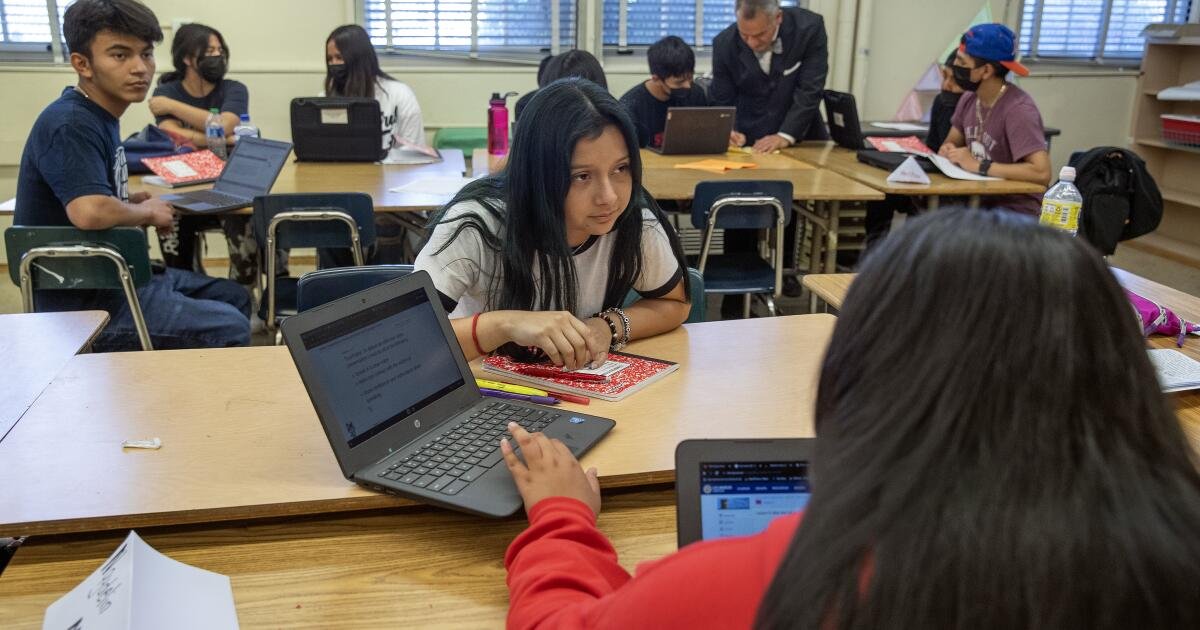

Student classroom screen time would be cut way back under a proposal expected to win approval Tuesday from the Los Angeles Board of Education, a remarkable reversal of years-long initiatives to equip students with computers and internet access — and a move that comes amid growing parental pushback on devices.
The resolution asks teachers to “encourage the use of paper and pen assignments” and also contemplates banning student access to YouTube as well as the gaming platforms Roblox and “Fortnite.”
Under the board motion, students would be kept away entirely from screens until the second grade, and after that, screen time would be tracked and limited.
The proposal, first put forward by board member Nick Melvoin, grows out of research suggesting that heavy regular use of digital devices harms academic, emotional and physical development. Also key to bringing the issue forward has been a group of activist parents.
The board resolution states, “While access to and developing skills in technology are critical in a digital world, excessive screen time can be associated with vision problems, increased anxiety and depression, addictive behavior, reduced attention span, difficulty managing emotions, lower academic achievement, and weaker cognition.”
The resolution stretches across four single-spaced pages of the Tuesday meeting agenda — a complex, detailed approach to a vexing issue.
If it passes, much of the policy-formation work remains to be done. The resolution, for instance, directs staff to “provide expected and maximum daily and weekly screen time limits for students delineated by grade level. (e.g., no more than one hour total a day or 5 total hours per week for 3-5th graders).”
The resolution stops short of suggesting precisely what those limits should be. Melvoin acknowledged that good lessons and education source material can be found on popular social media and YouTube.
“I want to respect teachers as professionals, and there’s a lot of great instructional content on YouTube,” Melvoin said in an interview. But there are three concerns I have with YouTube for students. One is it’s just more time on a screen. Two is the ads, and three is the auto play, and kind of the algorithm and the rabbit hole you can go down.”
A new focus on tracking screen time also is an element of the proposal.
An L.A. Unified spokesperson said recently that elementary school students average between 31 and 50 minutes of screen time a day in the classroom, adding that the district works with schools to ensure they are using technology responsibly and effectively. The use of one-to-one devices is left to the discretion of each school.
Melvoin said he doesn’t doubt the sincerity of the district on this issue, but added that it’s his understanding that the district is currently unable to track a student’s total screen time across all platforms, programs and devices.
There’s also a back-to-the-future aspect of the proposed policy.
The resolution could resurrect less-accessible computer labs to replace the current standard of a computer for every student. Computer labs were eliminated years ago for being out of date and educationally inadequate for a student’s daily and even hourly academic needs.
In this pushback against devices, the district would “encourage schools to utilize laptop carts and/or computer labs for second through fifth grade, while reducing the use of one-to-one devices.”
Moreover, the resolution would “prohibit elementary and middle school student device use during passing periods, lunch, and recess with limited exceptions for teacher-approved school work.”
This device ban would build on a cellphone ban that went into effect last year. Paper-and-pen also is a growing strategy among educators to combat the inappropriate use of artificial intelligence.
Also in the board motion is a call for a cost-benefit analysis: “The District shall also present a comprehensive itemized report of contracts related to classroom technology — broken down by central office purchased and school purchased — including but not limited to the purchase, maintenance, and upkeep of one-to-one digital devices, software, digital tools, and applications.”
The list of harms noted in the resolution is long, with cited sources including the American Academy of Pediatrics and a federal study that found that, as of December 2023, “one-half of teenagers ages 12-17 had four hours or more of daily screen time.”
The resolution also notes: “Addiction-like use of short-form video content — including YouTube and social media platforms — are correlated with higher levels of social anxiety among adolescents. The earlier age of first use and higher frequency of usage are significantly associated with increased emotional and behavioral issues and most negatively impacts middle school students.”
Source:
www.latimes.com