
India is on the verge of a major shift in its military strike strategy, driven by advancements in Rotating Detonation Engine (RDE) technology.
According to Saurav Jha, Founder and CEO of the Delhi-based aerospace startup D-Propulse, this new approach separates sheer numbers from high-precision targeting, turning financial cost into a tactical advantage.
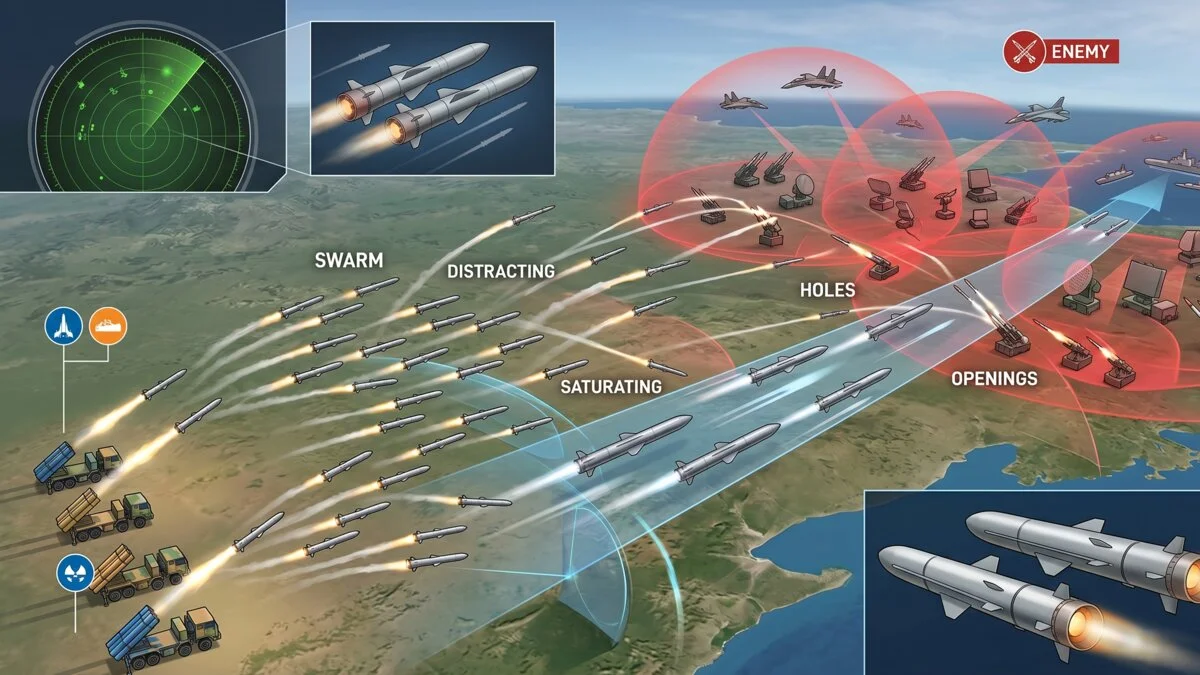
Jha suggests that affordable cruise missiles powered by RDEs could be launched in massive swarms to overwhelm enemy forces. This would allow India’s military to save high-end, expensive weapons, such as the BrahMos missile, for striking critical targets.
If put into practice, this strategy could completely change the financial balance of modern air defence operations.
The Mechanics Behind the Revolution
The core of this tactical revolution is the Rotating Detonation Engine itself.
Unlike traditional jet engines that rely on standard, slower combustion, an RDE operates by generating continuous, supersonic explosion waves that travel rapidly around a ring-shaped chamber.
This design creates more thrust relative to its weight and operates with much greater fuel efficiency—often estimated to offer thermal efficiency gains of 25% or more over conventional engines.
Most importantly, it is mechanically much simpler because it lacks moving parts like turbines and compressors. This simplicity drastically cuts down on manufacturing difficulties and expenses, making it far easier and cheaper to mass-produce RDE-powered weapons.
D-Propulse recently hit a significant benchmark by reaching Technology Readiness Level 4 with its 5-kilonewton (kN) RDE, which is integrated with an aerospike nozzle.
The company, backed by a recent ₹25 crore seed funding round, is rapidly advancing this indigenous technology under the guidance of former military research scientists.
While a 5 kN thrust output might seem small next to the engines of heavy traditional missiles, it is perfectly suited for lighter, extremely fast weapons and drones that hover over target areas.
By combining the RDE with an aerospike nozzle, the engine maintains high performance at various heights, from ground level all the way to high altitudes. This flexibility is vital for missions where a missile must either skim the terrain to avoid radar or travel high above the clouds.
The Financial Battlefield
The true strategic benefit of these RDE systems becomes clear when they are used alongside existing high-tier weapons.
Currently, elite cruise missiles like the BrahMos come with a heavy price tag of roughly $4.85 million to $5.5 million each, making them too costly to use in massive swarms.
Meanwhile, advanced enemy air defence shields, such as the Patriot or S-400 systems, rely on interceptor missiles that also cost several million dollars per shot.
Firing a massive barrage of highly expensive missiles to break through these shields is financially exhausting and cannot be sustained in a prolonged conflict.
Affordable RDE-powered missiles solve this problem.
Because they are much cheaper to build, they lower the financial risk of each launch while still achieving supersonic speeds between Mach 3 and Mach 5.
By firing a large swarm of these budget-friendly missiles, military planners can flood enemy air defence radars, forcing the adversary to use up their scarce and costly interceptor rockets.
Once the enemy’s defensive stockpiles are drained or their systems are overwhelmed by the sheer volume of targets, premium weapons like the BrahMos—or the upcoming BrahMos-II—can be fired.
With the path cleared, these high-end missiles have a much higher chance of reaching and destroying their intended targets.
In essence, this tactic turns financial efficiency into a weapon. Rather than trying to match an enemy’s missile count directly, India could force its adversaries to spend heavily by firing multi-million-dollar interceptors at relatively cheap incoming RDE missiles.
As a conflict drags on, this unbalanced exchange would severely weaken the opponent’s financial and defensive strength, opening clear windows of opportunity for decisive, pinpoint strikes.
Operational Flexibility and Self-Reliance
On the battlefield, these RDE-driven weapons could serve a variety of purposes.
Beyond just overwhelming enemy radars, they could act as high-speed loitering munitions that patrol disputed airspace before identifying and striking a target.
Because the engines are compact and lack complex mechanics, these missiles could be launched from almost anywhere. They could be fired from ground vehicles, naval ships, and possibly fighter jets, providing military commanders with highly flexible and widespread attack options.
Looking at the broader industrial impact, mastering RDE technology perfectly supports India’s goal of becoming self-reliant in defence manufacturing.
By developing this cutting-edge propulsion domestically, India decreases its reliance on imported hardware and firmly establishes itself as a global leader in next-generation aerospace research.
Because RDE technology is easily scalable, future and larger versions of these engines could eventually power heavy cruise missiles or even push hypersonic aircraft beyond Mach 5.
Finally, this strategy seamlessly blends into India’s modern vision of interconnected, multi-domain combat.
A massive swarm of RDE missiles could be launched in coordination with electronic jamming equipment, radar decoys, and other unmanned drones.
Together, they would create an incredibly complicated threat landscape capable of confusing even the most sophisticated air defence systems.
In these advanced scenarios, the goal goes beyond simply breaking through a physical barrier; it aims to paralyze the enemy’s automated decision-making systems through overwhelming speed, volume, and unpredictability.
Source:
defence.in