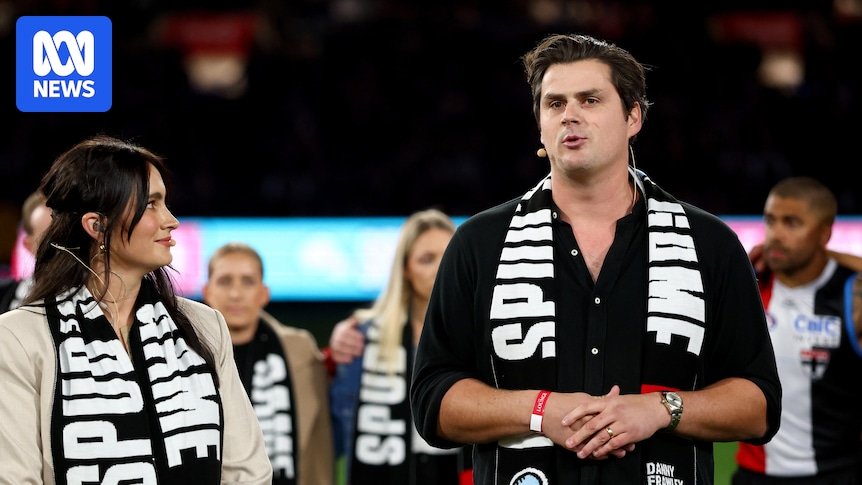

Tom Boyd, former AFL footballer turned mental health advocate, says the high-pressure environment of professional football means many players are struggling with mental health issues « under the surface ».
Carlton’s Elijah Hollands has been hospitalised this week after suffering a « mental health episode » during last Thursday’s game against Collingwood, sparking a broader discussion about the role of the AFL and its clubs to properly support players in this space.
Boyd, a former number one draft pick who retired at the age of 23 due to struggles with his mental health, says attention should not be focused on Hollands and the Blues specifically, but that a wider view should be taken on the issue as a whole.
Tom Boyd retired from the AFL in 2019 to address his mental health. (Getty Images: Quinn Rooney)
« I think it’s important to remember the magnitude of the suffocating nature of what’s going on at the moment, » Boyd told the ABC Sport Daily podcast.
« This is a position that I personally have been in, when you don’t feel like you can leave the house. You don’t feel like you can have a conversation with anyone.
ABC Sport Daily podcast
« You have a very small circle of trusted people you feel like you can rely on and feel like they support you.
« As this conversation has involved I think it’s critically important to remember the sheer magnitude of what this conversation means, not only for Elijah’s life but for the people close to him.
« I think we need to be talking about mental health as a topic and not spending time talking about the person or the club. »
Carlton has received criticism and a « please explain » from the AFL as to how Hollands was allowed to play in his condition.
Boyd said he believes players would feel comfortable talking to their clubs about mental health problems « all week, right up until game day » at which point it becomes more difficult.

Carlton president Robert Priestley (left) and CEO Graham Wright. (Getty Images: Quinn Rooney)
« As you do build up to these games of footy, there is a great hesitation from staff and support staff in particular to knock people off their game, » he said.
« The concept that someone would go in and say, ‘Hey, you don’t seem yourself today,’ as this player goes to put themselves out in front of 80,000 people, I think is a pretty questionable concept.
« But these are the sorts of severe consequences that could exist.
« What I can say is that heightened pressure as you lead into a game — not just any game, but Collingwood and Carlton at the MCG with 80,000 people there — it is incredibly difficult to pick out moments in time and then go, ‘Yep, there’s a trend of an issue here’ rather than people seeing erratic moments over any course of time.
Hollands admitted to hospital
« I think broadly speaking, the perspective of all of those people, and I mean this as genuinely as I can, is they want the best for everyone there and that is an important thing to keep at the forefront of our minds.
« Whether there were mistakes made or issues that could have been prevented, that’s another conversation. The intention of these people is incredibly pure, and that’s why they’re in the jobs they are in. »
Boyd said it was important not to consider episodes such as Hollands’s as an « isolated moment in time » and « it’s not like the game itself is the episode », but to view them as the culmination of a series of factors and events.
« From my perspective [Boyd’s mental health issues were] a cumulative effect over a number of years as I continued to have worse and worse issues, particularly around sleep and sleep leading into games, » he said.
If you or anyone you know needs help:
Lifeline on 13 11 14Aboriginal & Torres Strait Islander crisis support line 13YARN on 13 92 76Beyond Blue on 1300 224 636Headspace on 1800 650 890ReachOut at au.reachout.comMensLine Australia on 1300 789 978SANE on 1800 187 263
« The concept of turning up to a game of footy completely underdone from a rest and recovery point of view, unable to concentrate and really trying to use whatever means are necessary to get myself to concentrate and focus and prepare so that I don’t end up on the back page of the paper as the person who failed, it’s an extraordinary amount of stress to add onto what is already an incredibly stressful environment.
« I know a lot of players who have dealt with the challenges of preparation for games and this [Hollands] is an example where it spills out into something that is more visual than what a lot of players are dealing with under the surface. »
Boyd says although a game-day screening process of each player’s mental health would be difficult to implement, he believes there is value in a dedicated mental health round within the season.
« I see the opportunity, not to be a review of everything that’s gone wrong, but a great way to celebrate the incredible impact that our game does have as of this day.
« Equally to encourage a concerted effort over an extended period of time and use that as a review and celebration point for the progress we’ve made over the past 12 months.
« I would certainly be behind it. »
Source:
www.abc.net.au