




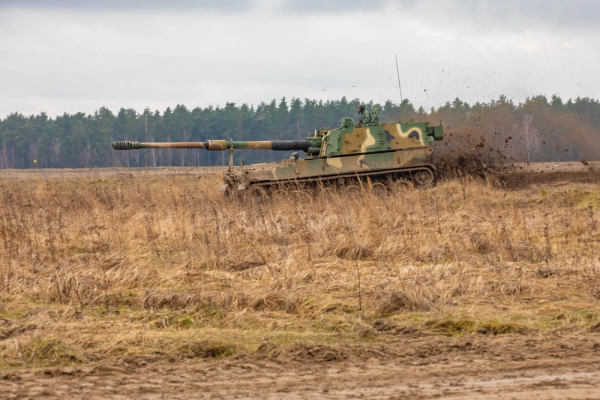

South Korea, already the world’s tenth largest defense exporter, is seeking an even greater share of the global defense market. To that end, South Korea is reorganizing its bureaucracy to support South Korean defense exporters. Externally, Seoul is targeting the European and Middle Eastern markets for defense sales, while highlighting South Korea’s contribution at the cutting-edge of advanced technologies.
In mid-October, President Lee Jae Myung appointed a special envoy, Kang Hoon-sik, to bolster defense industrial cooperation. Kang, who is also Lee’s chief of staff, almost immediately visited several European nations. Kang’s precise itinerary was kept vague, but it’s known that he met with officials from Romania and Poland.
The total value of ongoing defense procurement projects under discussion with European countries is approximately $56.2 billion, according to the presidential office.
A month later, Kang visited the United Arab Emirates in a bid to boost South Korea’s defense ties in the Middle East.
In addition to its new special envoy, the Lee administration is building a “defense export control tower” within the presidential office to coordinate interagency efforts. The goal is for South Korea to break into the world’s top four countries for defense manufacturing and exports. According to SIPRI, the current top four arms exporters are the United States, France, Russia, and China.
“Supporting defense exports is not a one-time effort but a sustained process that must be tailored to each partner’s characteristics and the stage of every project,” a presidential office spokesperson said around the time of Kang’s appointment. “The government will continue to pursue phased cooperation from working-level talks to top-level engagement.”
With NATO’s commitment to increase members’ defense spending from 2 percent of GDP to 5 percent of GDP by 2035, Europe is an obvious target region for South Korean defense exports. South Korea is already the second-largest arms exporter to European NATO members; Poland alone accounted for 46 percent of South Korea’s arms sales. Poland has praised South Korea’s fast delivery and willingness to adapt designs and productions to local requirements.
The strong and growing relationship is undergirded by the EU-South Korea Security and Defense Partnership signed in November 2024, which includes collaboration in defense industrial issues, and South Korea’s Individually Tailored Partnership Program with NATO signed in 2023, which includes cooperation in emerging technologies. At the June 2025 NATO summit in the Netherlands, South Korea and NATO agreed to form a director-general-level group focused on defense industry collaboration, tackling issues such as joint development, supply chain resilience, and standardization.
Jihoon Yu, with the state-run Korea Institute for Defense Analyses (KIDA), argued that South Korea’s defense industry can support NATO in meeting its short-term capability needs and enabling its long-term transformation by: 1) “offer[ing] NATO a credible and scalable alternative to overcome defense production bottlenecks,” 2) “sourc[ing] advanced defense technology with increasing potential for co-development and innovation,” and 3) “play[ing] a significant role in the logistics, maintenance, and training functions essential to sustaining NATO’s expanded operational commitments.”
According to Polish international affairs expert Przemyslaw Biskup, South Korea should focus on joint research, production, and development projects with European partners. As he explained in an interview with The Korea Herald, “American arms are the most advanced but costly, European arms support jobs and technology, and Korean arms offer fast delivery and good value.”
South Korean can emphasize their advantages and minimize their disadvantages by pushing for joint research and development, technology transfers, and local production in an era when the European countries are making a concerted effort to consolidate their arms market so they can take better advantage of economies of scale. South Korean defense firms already have experience setting up local production and supply chains in Poland and Australia, but there will also be Korean concerns about keeping its technology and skilled personnel.
In fostering its defense industrial cooperation with European partners, perhaps the greatest challenge that South Korea needs to overcome is whether Seoul has the political ability to commit to be “on Europe’s side” for decades to come.
Beyond Europe, South Korea’s defense exports to the Middle East have tripled over the past five years. This reflects the Middle East’s diversification away from the United States – Asian and European exporters made gains at the United States’ expense – and overall increased military spending in the context of the ongoing regional wars.
During Lee’s recent visit, South Korea and the UAE agreed to expand defense partnership beyond arms sales to include joint development and local production. This week, Lee also traveled to Egypt and Turkiye and expressed his hope for increased bilateral defense industry cooperation and joint production.
While targeting Europe and the Middle East as sales destinations, South Korea is focusing on positioning itself as a supplier of high-tech weapons. The Defense Innovation 4.0 program, announced in 2023, provided guidelines for introducing AI into defense systems. Lee has also highlighted South Korea’s advanced AI, drones, and robots.
The Seoul International Aerospace and Defence Exhibition (ADEX) in October 2025 – attended by 600 companies from 35 countries – was an opportunity for South Korea to showcase its growing emphasis on AI, autonomous platforms, hypersonic propulsion, and digital command integration. During ADEX, Defense Minister Ahn Gyu-back met with representatives from Estonia and Poland and reinforced Seoul’s commitment to expanding interoperability, joint training, and industrial cooperation.
Source:
thediplomat.com