


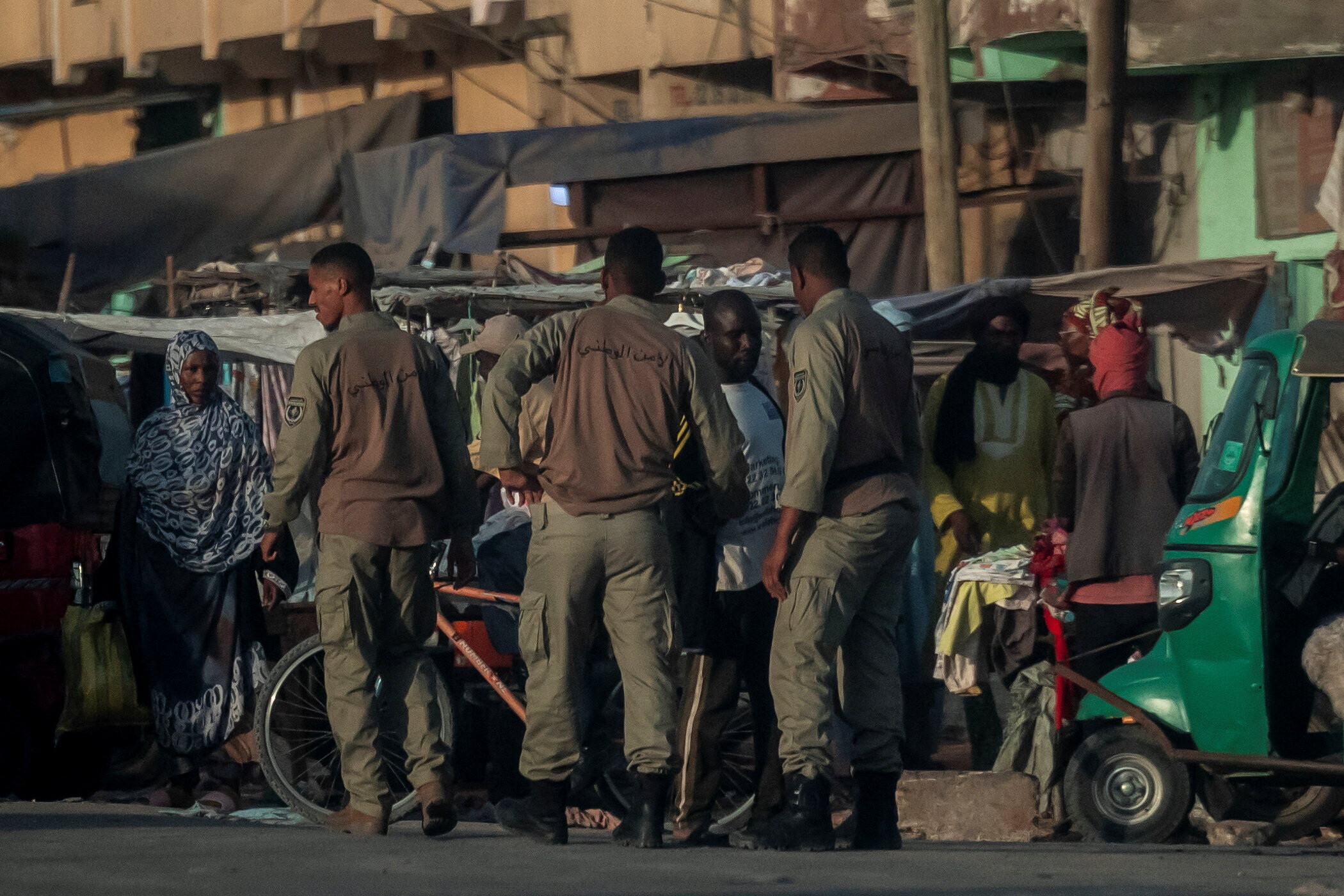


Mauritania sits at the edge of an unstable neighbourhood. In 2025, the Al-Qaeda-affiliated Jama’a Nusrat ul-Islam wa al-Muslimin spread across neighbouring Mali and surrounded its capital Bamako; today, Mauritania hosts 300,000 Malian refugees. To the country’s north, the unresolved status of Western Sahara remains a structural regional fault line. Intermittent clashes between Morocco and the Algeria-backed Polisario Front sustain a tense standoff between Rabat and Algiers, while renewed escalation would force Nouakchott to manage tensions between its northern neighbours.
For Europeans, security in Mauritania matters for three reasons. First, the country acts as a buffer to ensure Sahelian instability does not reach the Atlantic coast and Europe’s extended southern neighbourhood. Second, Mauritania remains a key European Union security partner in a region where several military coups have brought in regimes opposed to European interests. Third, Mauritania’s capital, Nouakchott, is key to European migration management along the Atlantic route, which stretches from west Africa to the Canary Islands.
Mauritania is also NATO’s only formal partner in the Sahel region, participating in defence capacity-building programmes such as the Mediterranean Dialogue and acting as the alliance’s last relatively stable Atlantic anchor in the Sahel.
The Gulf’s growing interest
But Europeans and NATO are not alone in having a stake in Mauritania’s future. Gulf Arab monarchies, especially Saudi Arabia and the United Arab Emirates (UAE), are increasingly relevant economic actors in Nouakchott. America and Israel’s actions against Iran are having repercussions in the Gulf and will likely, in the short term, constrain fiscal space and redirect political attention toward regional security.
Over the longer term, sustained volatility may reinforce Riyadh and Abu Dhabi’s ongoing geographic hedging toward other regions, including Africa.
However, the Gulf Arab role in Mauritania is not new. Since the country became independent from France in 1960, Gulf Arab charities have funded mosques, religious education and Arabic cultural initiatives to contribute to Mauritania’s Arabisation policies. The Gulf’s soft-power influence has also reinforced the ruling Arab-Moorish groups (Beydanes) dominance over the Black Moorish (Haratins) and Afro-Mauritanian minorities.
Following the Arab Spring uprisings in 2011, Gulf Arab rivalries became more overtly political in Mauritania. Qatar supported political Islamist actors, while Saudi Arabia and the UAE backed ruling elites and security institutions. During the 2017 Gulf crisis, Nouakchott sided with Riyadh and Abu Dhabi, cutting ties with Doha and securing financial pledges through the Saudi development agency.
Now the UAE is Mauritania’s main import partner and a major investor in infrastructure and energy; Saudi Arabia’s economic diplomacy is evident through credit facilities, business councils and mining partnerships, channelling around $1bn into Mauritania in loans and grants.
The new Pact for the Mediterranean
Gulf Arab engagement in Mauritania has three main objectives: establishing a presence in a country which connects north and west Africa and the Sahel to the Atlantic Ocean; building influence across the Arab-Islamic world; and supporting their own economic diversification.
Mauritania, for its part, is seeking to diversify its economic partnerships to avoid over-reliance on any single actor. Its narrow export base, food-import dependence, rapid demographic growth, regional security threats and mounting climate pressures mean Nouakchott needs to attract investment and boost growth—lest its societal faultlines deepen.
Here, the EU’s Pact for the Mediterranean can play a role. It uses economic partnerships to anchor sustained cooperation between the EU and its southern neighbours, and includes Mauritania and the Gulf states as external partners. The pact will allow the EU to coordinate more effectively with influential Gulf monarchies and align their interests with Mauritania’s stability.
As the Iran conflict increases financial and political pressures, Gulf Arab states may be more willing to work with the EU to secure a coordinated, strategic position in Mauritania.
The Mauritanian offer
Europe’s cooperation with the Mauritanian government is important for migration management in its southern neighbourhood. The country is a key departure point for migrants attempting the dangerous journey from west Africa to Spain and—though overall numbers declined in 2025 after Mauritanian authorities tightened controls with Spanish and EU assistance—Europeans are keen to retain this cooperation in their migration policy. The overall view is to prevent an increase in crossings to the Canary Islands.
Mauritania is also relevant for Europe’s economic diversification agenda. Its ocean waters are important for European fisheries, particularly since the EU halted fishing arrangements with Morocco over the Western Sahara issue. Developing offshore gas reserves allows Mauritania to become a significant energy partner for Europe as the latter seeks to diversify its energy supplies away from the Gulf.
In the meantime, Gulf monarchies are also diversifying their energy revenues, a feat becoming more important given the uncertainty around energy supplies in the fallout from the Iran conflict.
Mauritania’s potential for renewable energy, especially green hydrogen, also aligns with European decarbonisation goals and Saudi-Emirati ambitions: both seek to advance their energy security through investing in the green energy space. In addition, large iron ore reserves in Mauritania’s north are poised to support its domestic steel industry while diversifying Europe’s steel supply chains, which are increasingly dominated by China.
Gulf Arab monarchies also fear the spread of jihadism to other Arab-Muslim countries. To counter extremism in the Sahel, Saudi Arabia and the UAE initially strengthened their military cooperation with Mauritania by providing €130m to the (now disbanded) G5 Sahel and deploying advisers to train Sahelian militaries in Nouakchott. The UAE has also delivered transport aircraft and armoured vehicles, which are critical assets against jihadi infiltrations across Mauritania’s borderlands.
Why the dynamic matters for Europe…
The dynamic between Mauritania and the Gulf Arab states is consequential for Europe. On the one hand, Gulf Arab financing (which is faster and with fewer conditions than European assistance) can secure the loyalty of local elites and shape political dynamics. But the diplomatic fallout between Saudi Arabia and the UAE could lead to rival support creating divisions within Mauritanian politics and fuel ethnic tensions for jihadist organisations to exploit.
On the other hand, Gulf Arab security support and investment in energy, infrastructure and extractives mirrors many EU priorities in Mauritania, offering fertile ground for structured cooperation. The Gulf states’ military investments match European security interests, meaning Europeans can leverage assets that Gulf countries lack. This includes technological and know-how (which can be communicated to Mauritanians), expertise in institutional capacity-building, access to the EU (the largest global trade bloc) and a more predictable approach to funding.
As the world becomes less conducive to European conditionalities, the flexibility of Gulf Arab funding is becoming more attractive across the global south, to the detriment of Europe’s rule-heavy cooperation model. But as European budgets tighten and Gulf states face mounting security pressures, they will need to allocate resources strategically—and strengthen the case for coordinated stabilisation and economic initiatives.
…and what Europeans can do
Mauritania and the Gulf Arab states are not formal members of the EU’s Pact for the Mediterranean; nonetheless, their importance to the EU’s southern neighbourhood paves the way for trilateral cooperation. From renewable energy to digital services, from water-source management to skills creation, the pact covers sectors where Gulf Arab monarchies have a stake in Mauritania and other African countries. Europe should combine its technological prowess, capacity building and market access with Gulf liquidity and funding flexibility; each side can capitalise on the other’s comparative advantages.
The election of Sidi Ould Tah, a Saudi-backed Mauritanian economist, as chairperson of the African Development Bank (AfDB), may allow European and Gulf policymakers to more easily combine their financial instruments and support complementary projects on infrastructure and renewable energy. In turn, clean energy projects could generate cheap green hydrogen for European industries, chiefly the green-hydrogen plant jointly planned by German Conjuncta and Emirati Infinity.
Such investments, alongside capacity-building to strengthen governance, technical skills and resource management, would create a conducive environment for private investment in Mauritania’s industry. Access to European and Gulf markets would drive profitability, while helping Europe diversify its supply chains and contribute to substantial growth and employment opportunities in Mauritania.
In parallel, the EU should explore joint financing arrangements that involve Saudi Arabia and the UAE in separate initiatives to avoid potential clashes and include Mauritania in the core collaboration framework of EU-Gulf Cooperation Council policy dialogues. EU members states can play complementary roles: France and the Czech Republic on security, Germany on energy and development, Spain on infrastructure and trade, and Italy on agriculture and fisheries through the Mattei Plan.
Britain also spearheads security cooperation through NATO, while British Petroleum (alongside US company Kosmos Energy) is developing the Greater Tortue Ahmeyim gas basin.
*
The crisis in the Gulf has sharpened the strategic case for EU-Gulf collaboration in Mauritania. With energy routes under threat and supply chains exposed, Mauritania can help secure energy and economic resources
The crisis in the Gulf is sharpening the strategic case for EU-Gulf collaboration in Mauritania. With energy routes under threat and supply chains exposed, Mauritania—with offshore gas, green hydrogen potential and critical minerals—can help secure energy and economic resources.
Gulf monarchies, for their part, have incentives to economically de-risk from their own region, and anchor assets and influence beyond the Strait of Hormuz. By aligning their efforts, Europeans and Gulf Arab partners can develop a security-and-growth offering which reinforces Mauritania’s domestic prospects while advancing their own security and economic interests. In this, the EU’s Pact for the Mediterranean can assist.
The European Council on Foreign Relations does not take collective positions. ECFR publications only represent the views of their individual authors.
Source:
ecfr.eu