






Warning: This article contains descriptions of violence that may be disturbing some readers.
« Suddenly, while she was watching television, he attacked her using two large knives, » reads the vivid and disturbing description of a recent murder in the Spanish capital Madrid. « One was serrated and the other was a ham knife. He inflicted 67 stab wounds, many in the heart and lungs, and others on her leg, neck and stomach. He then washed the body with hydrogen peroxide and alcohol, carried it into the bedroom, and called the police. The couple had a son and two daughters. He was known in the neighborhood for psychological abuse and compulsive jealousy. ‘They were always together,’ reported a neighbor. ‘And when they weren’t, he would yell at her and demand to know where she had been.' »
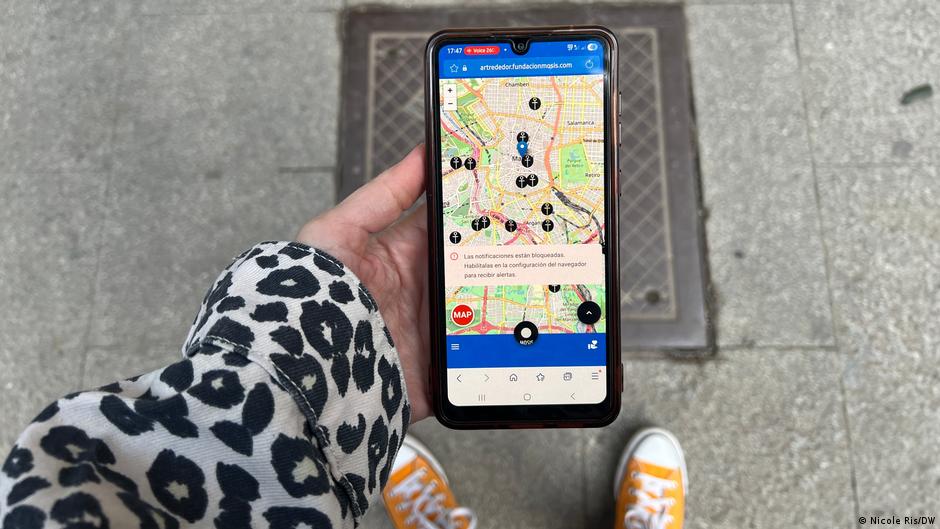
This is Case 078 on Artrededor, a website and app that shows users where a femicide took place on a virtual map. A cross marks the area surrounding where a woman was murdered by her partner. It also provides a graphic description of the crime in text and audio form. Case 078 relates to one of the 157 women who have been killed in the Madrid region over the past 20 years. The Artrededor app is updated annually.
« I want everyone to know where a woman was murdered in their neighborhood so they can visit the site and learn her story, » says Jana Leo, the Spanish conceptual artist who developed the app together with her sister Isabel, using official data. They want to raise awareness about femicides and the fact that they can happen right next door. They believe that only through awareness can such violence and murder be prevented.
An uncomfortable map
Today, Leo is in Madrid to present the project along with a book on the topic that was published before the app was developed.
« It makes me uncomfortable, » says one woman at the event while looking at the app’s map on her phone.
Another leafs through the book and finds the murder of a neighbor. Case 080. « It’s an odd feeling. The police were suddenly at the door and said they had found a woman, that she’d been dead for several days. »
Despite the discomfort, a lively discussion ensues, with people talking about the need for boys and young men at school and university to learn about violence against women. Some say that men also need to be taught how to react if they feel anger towards women and what to do with their feelings. Others suggest that educational programs in companies would also be a good idea.
Spain has been seen as role model in the European Union for its fight against feminicide. In 2004, it was the first member of the bloc to recognize gender-based violence as a systemic problem and to introduce appropriate laws and other measures. For 20 years, detailed statistics have been available. The numbers have started to decline slightly. In 2025, men killed 48 women in Spain.
There are also 461 specialized criminal courts in Spain, which deal only with cases of violence against women.
However, there have been problems, too. Last year, a number of electronic bracelets equipped with GPS tracking systems, which convicted offenders are supposed to wear to protect potential victims, turned out to be faulty. They were easy to hack and those who wore them could not be properly located. This year, there was an uproar when it was made public that six of 10 women murdered in January and February had previously filed reports with the police.
« Sometimes we realize that we do not arrive in time and that the protective measures are sometimes not agile and effective enough, » the Spanish Minister for Equality Ana Redondo conceded.
AI can help detect trauma
In the constant search for potential tools, artificial intelligence (AI) is also being examined for its potential to help. A small team at the Carlos III University in Madrid is conducting research into whether AI can detect from a woman’s voice whether she is the victim of violence.
« The trauma suffered by victims can be measured in their voices because it changes the way they express themselves, sound and react, » explains one of the researchers Carmen Pelaez Moreno, an associate professor in the Signal Theory and Communications department.
Over the past few years, 150 women, including 50 victims of male violence, have participated in the project, in which psychologists are also involved. In about 80% of cases, AI has been able to recognize victims of violence.
Pelaez Moreno thinks part of the potential in the technology is that the women often found it difficult to recognize themselves as victims of violence. The new technology could help detect early warning signs in doctors’ offices or police stations, for example.
« When somebody has a blood test and it turns out their iron level is low, this is checked in case something more important is to blame. This is how the AI tool works too, like a warning and advice to take a closer look. It could be that this person is a victim of violence, » the professor explains. More funding would be needed before such an AI tool could be used on a larger scale.
For app inventor Leo, what is important is not to forget. She considers Artrededor a method of raising awareness and supporting those affected by violence.
« That’s what you do for war victims too, » she said.
This article was translated from German.
If you or somebody you know might be experiencing or have experienced any kind of gender-based violence, the website lila.help lists trustworthy helplines and NGOs that offer support in almost every country in the world.
Source:
www.dw.com