


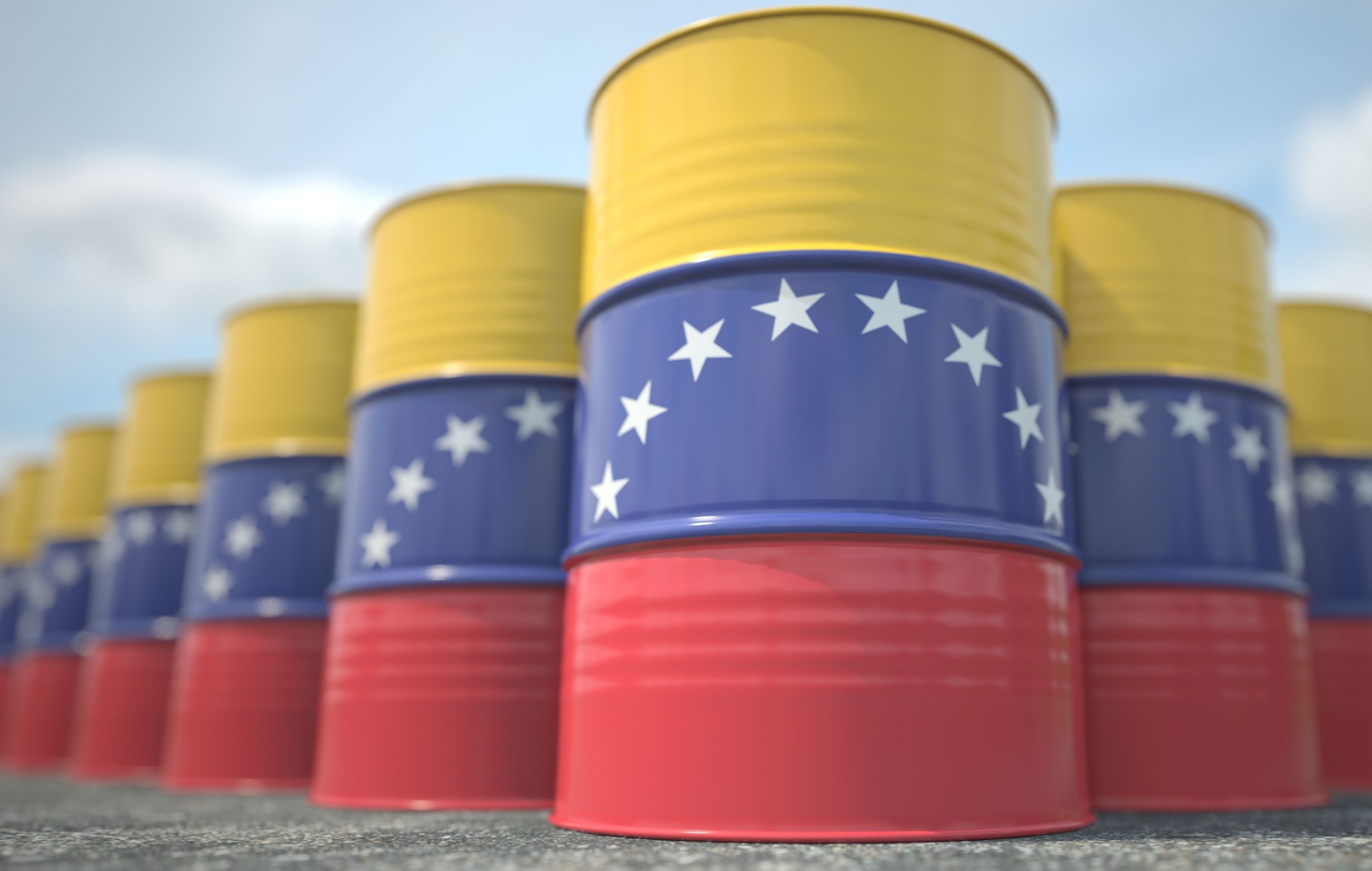

The US seizure of Venezuelan leader Nicolás Maduro is being framed publicly as a counternarcotics and democracy-restoration operation. But it is oil — not cocaine or fentanyl — that sits at the center of events. Venezuela’s vast reserves, its role in gray and black energy markets, and its position within a broader geopolitical contest over oil supply explain far more about the timing and scope of the intervention than narcotics enforcement ever could.
Venezuela is no longer the oil superpower it once was. Production has collapsed from more than three million barrels per day in the late 1990s to under one million today, placing the country outside the top tier of global producers. Still, oil remains the backbone of the Venezuelan economy, accounting for roughly 95 percent of export revenue. In a world where energy markets are increasingly shaped by sanctions, supply fragmentation, and political risk, even marginal barrels matter — especially when they are sold at a discount and routed outside formal channels.
In recent years, Venezuelan oil has flowed largely into opaque markets, particularly to China, often via intermediaries and “ghost ships” that mask origins to evade sanctions. These barrels are not priced at global benchmarks; they are sold cheaply, quietly, and strategically. The result is not simply lost revenue for Caracas, but distorted price signals across the global oil market. Interventions disrupt price discovery. Sanctions do not eliminate supply — they reroute it into less-transparent channels, where prices convey less information and capital allocation becomes more politicized.
The US blockade and seizure of sanctioned tankers and the disruption of naphtha imports, critical for transporting Venezuela’s heavy crude, had already begun constraining production even before the military operation. Storage tanks filled, wells were shut, and exports stalled. Yet global oil prices barely moved. That muted response reflects a market already awash with supply and conditioned to treat Venezuelan output as unreliable. Oil markets have learned to discount politically fragile production, which means that sudden interventions often have less immediate price impact than policymakers expect.
The longer-term implications, however, are more significant. A successful political transition followed by large-scale foreign investment could eventually bring Venezuelan production back toward its pre-collapse levels — perhaps to 2.5 million barrels per day over several years. That would represent a meaningful supply shock, potentially lowering global oil prices by several percentage points over time. Such an outcome would benefit refiners, particularly in the US, that are configured for heavy crude, while putting downward pressure on higher-cost producers elsewhere.
But that optimistic scenario rests on fragile assumptions. Oil production is not simply a matter of drilling holes; it requires institutional stability, secure property rights, skilled labor, functioning infrastructure, and credible contracts. Venezuela’s oil collapse was not caused by geology, but by decades of state control, politicized management, expropriation, and capital flight. Reversing that damage will take time and discipline.
There is also a broader pattern worth noting. Within a single week, the United States has been exerting escalating pressure on three oil-producing nations across three continents: Venezuela, Iran, and Nigeria. Whatever the specific justifications in each case, the pattern suggests a strategic shift. A decade ago, Donald J. Trump rose to prominence as an anti-interventionist critic of foreign entanglements. Today, the US is asserting itself as an active enforcer of energy order, using sanctions, seizures, and force to reshape supply flows.
Among other reasons, it matters because energy markets thrive on decentralized discovery and suffer under centralized control. When oil becomes an explicit instrument of geopolitical maneuvers, prices reflect power as much as scarcity. Capital flows follow political signals rather than entrepreneurial ones. The result is not necessarily higher prices, but noisier ones: prices that convey less reliable information about underlying supply and demand.
Discounted oil sold into black markets sustains regimes, finances patronage networks, and reshapes global trade patterns. Controlling that flow is economically consequential in a way that narcotics interdiction rarely is. Whether the US intervention ultimately stabilizes Venezuela or entrenches a prolonged foreign presence, its lasting impact will be felt less in Caracas politics than in the structure — and credibility — of global oil markets.


