[ad_1]
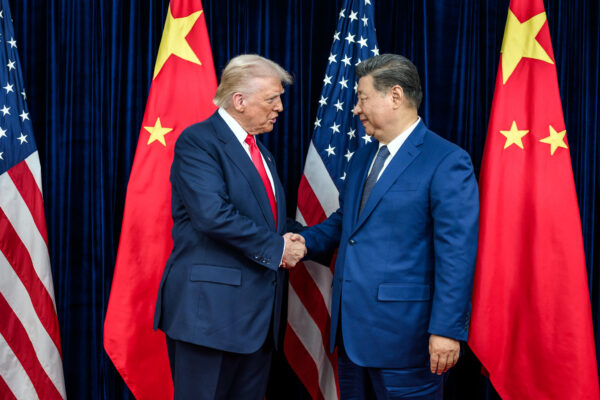
Amid global tensions involving Venezuela and Iran, there is hope that the scheduled meeting between U.S. President Donald Trump and his Chinese counterpart Xi Jinping in Beijing in April 2026 could arrest the United States’ aggressive and predatory policies. A possible Trump-Xi détente could also reduce risk-taking in the Taiwan Strait, and push China to take a different position on the Ukraine war.
In 2025, Trump accepted an invitation from Xi to visit Beijing in April 2026. The call, as U.S. media reported, was initiated by Xi, partly over China and Japan’s war of words over Taiwan.
This was preceded by a Trump-Xi meeting at Busan, South Korea, on October 30, which the U.S. president said was “highly successful.” The meeting took place in the backdrop of retaliatory tariff measures by both sides, and appeared to have eased tensions.
While the Busan meeting and the subsequent engagements between the two world leaders are being seen as a temporary truce at least on the economic front, they do little to change the structural issues and assuage the U.S. about the consequences of China’s rise. New pressure could also build up following Beijing’s warning that it could impose retaliatory tariffs on the U.S. in the event Washington imposes a 25 percent tariff on countries trading with Iran. Like many others, China also imports cheap Iranian oil.
Importantly, however, the Trump-Xi meeting appears to have implications for India. Trump’s tariff shock, the delay in finalizing a India-U.S. trade agreement, and a certain diplomatic chill have worked to rock the once promising “strategic partnership,” and these events have pushed New Delhi to try to normalize ties with Beijing.
A Chinese Communist Party delegation arrived in New Delhi on January 11, the first since the 2020 Galwan Valley clashes. The CCP officials met BJP and RSS leaders on January 12 and 13, respectively. Indian National Security Adviser Ajit Doval is expected to visit China soon, although no specific dates have been announced, and this will keep the diplomatic track moving with efforts to improve relations over the vexed border issue.
Impact of Sino-U.S. Overtures
At the global level, China-U.S. relations are bound to be consequential, with implications on trade in commodities and metals and on supply chains.
Bilaterally, trade in fentanyl components, technology, agricultural trade, and rare earths exports control are core issues for the United States. In particular, disagreements over how to handle the fentanyl issue delayed the China-U.S. trade agreement, which could have been possible as early as March this year. This did not materialize.
Also, even as Chinese and U.S. officials negotiated the trade and economic deal in the backrooms, publicly Beijing continued to pursue a combative approach and put restrictions on soybean imports from the U.S., with diversification leading to increased imports from Brazil and other countries in Latin America. The fact that the U.S. and China are truly interdependent has helped them not only battle hard in trade terms but also respond swiftly when backroom options were available.
It is undeniable that China has had more leverage in its bargain with the U.S. as compared to any other country. China’s manufacturing and export competitiveness and near monopoly in sectors such as rare earths elements were central to its strategy. Equally important was China’s role as a consumer of American industrial and agricultural products, which is not accounted for adequately by Western analysts.
After the Busan meeting, the U.S. reduced its tariffs on China from 57 percent to 47 percent, besides cutting fentanyl related tariffs from 20 percent to 10 percent. The chip-related restrictions remain in place. China relaxed its exports controls related to rare earths and suspended investigations of U.S. microchip companies. It also suspended additional tariffs on U.S. imports, which will help soybean exports to China.
Consequences for India
The Trump-Xi meeting has consequences and lessons for India. One of the ways it can help India is by boosting its commodities sector exports to China significantly after the Washington-Beijing trade war dampened Chinese demand over the last 11 months or so.
However, this does little to assuage India’s general concerns with reference to its trade imbalance.
Trump’s use of the term “G-2” on the eve of his November 2025 talks with Xi, referring to the U.S. and China as two great powers, would certainly have ruffled a few feathers in New Delhi as this has an old history. The expression emerged in 2005 in a book by American economist Fred Bergsten in reference to transatlantic relations and later in the backdrop of the return of the bipolar world order with the rise of China, which, by 2009, was about to surpass Japan and had a significantly stronger economic momentum compared to India.
Many see the G-2’s return as a sign of India’s deepening diplomatic isolation. Prime Minister Narendra Modi skipped the U.N. General Assembly in September 2025 and the ASEAN summit in Malaysia in October the same year. He also stayed away from attending the COP30 summit in Brazil.
At the same time, India-U.S. relations took a hit as a consequence of the bonhomie between Trump and the Pakistani leadership. Trump’s claims of playing a decisive role in halting India-Pakistan clashes in May 2025, as well as his revelations of India’s military losses during Operation Sindoor, do not sit well with the Indian leadership. New Delhi is unwilling to accept Trump’s mediation and the G-2 reference. This narrows India’s choices.
The return of the G-2 and the apparent normalization of China-U.S. relations could stall any progress in China-India ties.
Some scholars have noted that China-India relations progress when China’s relations with the U.S. are strained. This was seen in the early 1990s after China faced sanctions following the Tiananmen Square massacre. Conversely, a softening of China-U.S. relations would make it harder for India to get a better trade bargain from China than if the tensions persisted.
Bilaterally, China also seems determined to compel India to accept its centrality in Asia and a return to such posturing cannot be ruled out, despite recent progress in relations.
The return of bipolarity, which appears to be more like a duopoly, would demand a more active Indian foreign policy and diplomacy. India, therefore, faces both geopolitical and geoeconomic uncertainties under Trump, who is intent on being the lone architect of the order and thus challenges several of India’s assumptions on what course to follow.
India needs a nimble multilateral strategy and bilateral economic diplomacy abroad and a fresh look at its domestic industrial and innovation strategy.
Over the last two decades, particularly since the India-U.S. nuclear deal, India’s core concerns with regard to trade, investments and technology, and regional security have worked out fairly well due to the China-U.S. rivalry and India’s partnership with the liberal order. However, in the new era, the older playbook may have run its course as Trump demands more from India. A larger lesson for India is to expand its leverages and not be apprehensive about interdependence.
Originally published under Creative Commons by 360info™.
[ad_2]
Source link