


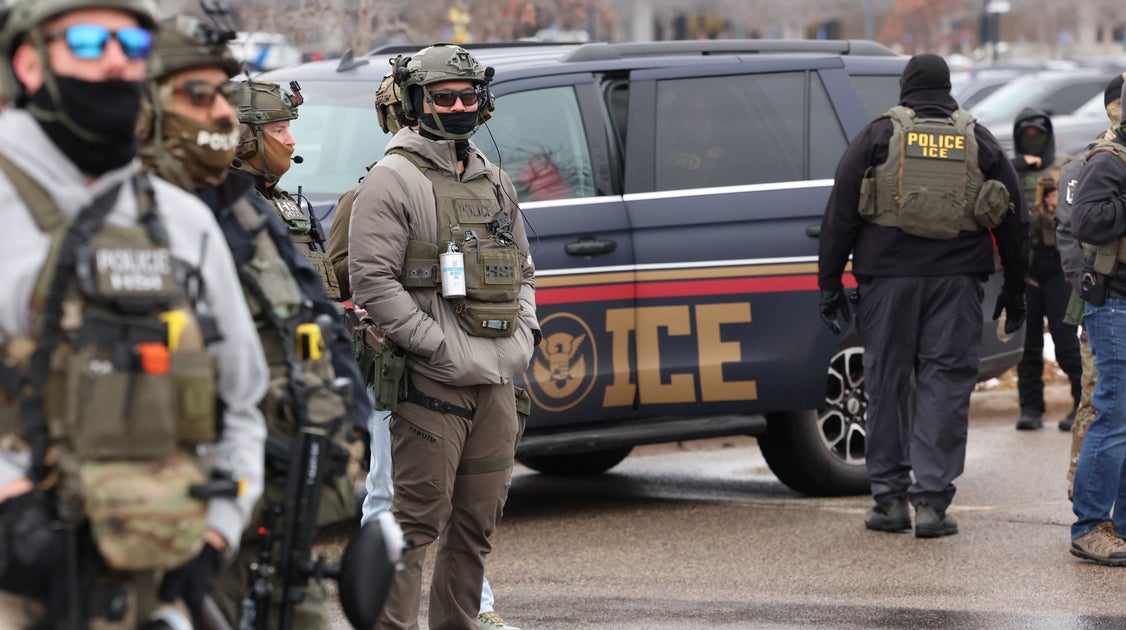

In the days following the killing of Renee Good by ICE agent Jonathan Ross, ICE agents in one local office were called into a meeting.
There, they were given what some would consider commonsense guidance for law enforcement officers.
“We were briefed on avoiding standing in front of cars, wherever possible,” one agent present at the meeting told HuffPost. “And ICE agents were reminded to also tell other partners to not stand in front of cars.”
What’s more, he recalled, agents were told that if a car is intent on leaving the scene of an incident, it’s better to simply let them leave.
“It’s better to just let it go away, we can log its plate, we can call it in, someone else can get it,” the agent recalled being instructed. (The agent asked to remain anonymous because he is not authorized to speak publicly.)
The impetus for the meeting was obvious. In the moment before Ross shot her, Good had been involved in a traffic dispute with ICE agents in her neighborhood. Ross had walked around and then in front of her car, filming on a cellphone, and ultimately stood directly in front of her vehicle. Then, as another agent lunged to Good’s driver’s-side door and reached his arm through the window, Good turned her steering wheel away from Ross. She appeared to be trying to drive away, but Ross opened fire.
“They train us that vehicles are deadly weapons and so we need to be cautious around them,” the ICE agent said. “Not standing in front of vehicles, especially when the driver is still there, is common sense.”
It’s unclear if agents at other offices were given a similar brief. DHS spokesperson Tricia McLaughlin did not address HuffPost’s specific questions about the meeting, saying instead in a statement that “our officer acted according to his training” and listing some of Ross’s credentials.
But the meeting suggests that at least some officials within the U.S. immigration enforcement apparatus were disturbed by Ross standing in front of Good’s car before the fatal shooting.
“What [Ross] does is cross in front of, and stay in front of, an occupied, running vehicle,” Eric Balliet, a veteran former federal agent who oversaw use-of-force investigations for Homeland Security Investigations, a branch of ICE, told CBS News after the shooting. “You should not be intentionally putting yourself in front of a vehicle unless absolutely necessary.”
Gil Kerlikowske, who previously served as both commissioner of U.S. Customs and Border Protection — Border Patrol’s parent agency — and chief of the Seattle Police Department, told The Washington Post, “You never should put yourself in that position in front of or behind the car.”
“City police officers know this,” he said.
In an interview with HuffPost, he said that the kind of work immigration officers are doing during Donald Trump’s second term doesn’t line up with what they’ve historically been trained to do.
“This kind of stuff — just walking through a Home Depot lot or something like that — is not what they do,” he said. “It’s been pretty clear in the shootings inside vehicles, the standing in front of vehicles … tossing tear gas, shooting people with pepper balls, body-slamming people.”
The ICE agent who spoke to HuffPost made a similar point.
While it’s unclear what led to the confrontation between Good and Ross, he said, “that’s not what we are trained to do, that’s not our experience. We don’t have riot training. It’s all a lot for us.” (Many immigration agents now walking the streets of America’s cities were previously patrolling the U.S.-Mexico border, or working on targeted operations focused on specific subjects.)
Ross’s law enforcement history could provide crucial context in this case.
He was a member of Border Patrol from 2007 to 2015. An independent report authored by the Police Executive Research Forum covering some of those years flagged a trend of officers placing themselves in front of vehicles in order to create justification for deadly force.
The report, portions of which were published by the Los Angeles Times in 2014, studied 67 Border Patrol shooting incidents from 2010 through 2012, finding that “it is suspected that in many vehicle shooting cases, the subject driver was attempting to flee from the agents who intentionally put themselves into the exit path of the vehicle, thereby exposing themselves to additional risk and creating justification for the use of deadly force.”
In November, weeks before the fatal shooting in Minneapolis, Customs and Border Protection advised personnel in a memo on “vehicle extraction operations” that they should “safely block the target vehicle with other vehicles, ensuring officers/agents avoid unsafe positioning,” journalist Ken Klippenstein reported Friday.
The ICE agent told HuffPost it did not appear as though Ross’s life was in danger when he fired the shots that killed Good.
But given the sheer number of immigration agents now interacting with the public, he said, it follows that there’s a higher risk of shootings involving them.
“This is the really troubling thing about it,” the agent said. “Any one of us could have been in that situation, could have panicked, could have pulled the trigger.”


